Ethiopia
Visited: May 2026
We had the chance to visit Ethiopia during the Eid al-Adha holidays. We only had a couple of days and stayed the entire time in the capital, Addis Ababa. We tried to make the most of our short stay, which proved to be no easy feat.
While we had the option to get a visa on arrival, we decided to apply online beforehand to avoid the airport queues. A 30-day tourist visa cost us $62, and we received it in less than 24 hours.
Our plane arrived in Addis Ababa about 40 minutes early, and going through customs was incredibly fast. Unfortunately, we then waited about an hour and a half to get our luggage. Meanwhile, we exchanged $50 to ensure we had some local cash to start with. The rate at the airport matched what we saw online exactly (1 USD → 161 ETB), though we had heard we could get a better rate on the street later. Once we finally grabbed our bags, we tried using the local RIDE app to hail a taxi. We couldn’t find the designated pickup spot and ultimately gave up, ending up paying double ($6) for a standard airport taxi.
Day 1: A stroll through AA
Since we arrived at 2 am, we slept like logs even though the room was uncomfortably warm. We had an alarm set to 8 am, but we snoozed it really quickly. We were up at 9 and headed downstairs for breakfast, which was amazing. A buffet spread with even Beef Tibs (local chunks of beef sautéed with onions, garlic, and pepper) and all the sweets you could ask for. We got a first taste of Ethiopian coffee and a juice that was so thick we couldn’t even pour it out of the pitcher.
We tried to use the RIDE taxi app again to get to the city center. The fare was picked straight away, but the driver never showed. Third time’s the charm, and we finally got a taxi. It cost us 600 birr to get to the Adwa Memorial.
We walked around the memorial building dedicated to the fight against colonialism, more precisely, the victory over Italy at the Battle of Adwa in 1896, but we weren’t allowed in because it was closed. We took a small detour down Churchill Street to the Tomoca cafe. You can find this coffee shop all around town, but this location was the first in town and features different displays, a wooden interior, and no chairs. Everyone enjoys their coffee together at the standing tables.
We then walked back up the hill to St. George’s Church. The church wasn’t open, but we found out later that this is regular in Ethiopia, as people pray outside. The churches are then open during ceremonies and Sunday prayers.


Following the streets around, we walked through the area called Piassa (sometimes spelled Piazza). We read everywhere that we have to visit this old part of the town, but to be honest, it didn’t feel much different than any other parts. If we hadn’t read it, we wouldn’t know that we were walking through a “spot-to-see” in Addis.
Our next stop was the National Museum of Ethiopia. It was a small museum with a very cheap entrance fee (50 birr → 0.3 USD), but I liked it. It took us through ancient history and all the way to religious differences and how they shaped the different parts of the country. But the most famous “inhabitant” of the museum was, of course, Lucy (Dinkinesh), the 3.2-million-year-old fossilized skeleton of Australopithecus afarensis. We could see the skeleton, read about the discovery, and the impact that it had on our understanding of human evolution.
The Facts Corner
Lucy (known to locals as Dinkinesh, meaning "you are marvelous") was discovered in 1974 in the Afar region. Her skeleton is surprisingly complete, with about 40% of the bones recovered. Lucy’s discovery shifted the timeline for bipedalism in human ancestors, providing key evidence that walking upright evolved before a larger brain size. In other words, we walked on two legs before we got smart!
Fun fact: Lucy was named after the Beatles’ song "Lucy in the Sky with Diamonds," which was playing repeatedly on a tape recorder at the camp the night she was discovered.
After the museum, we headed south with a small stop at the Kideste Kidusan Mariyam Orthodox Church across the street. The next stop was the Holy Trinity Cathedral. However, we couldn’t go in since we had to pay a 1,500 birr entrance fee each and we had no money. We “cleverly” didn’t exchange any more money near the hotel, because we were sure we would see an exchange around… well, we didn’t! We left the Cathedral for another day then.
We continued south past Unity Park and Friendship Park. We wanted to visit Unity Park as it contained Emperor Menelik II’s Palace, but all the gates were closed. On top of that, there were army guys at every corner with machine guns. We walked past the park a few more times on the other days, and it was always the same. Not sure if we just didn’t find the correct entrance, or if it was fully closed due to the upcoming elections. We didn’t stop in Friendship Park because it was paid to go in (I think it was 30 ETB), but it looked nice from the outside.


It was time for coffee! Instead of finding a cafe, we found a woman who was making coffee in a small park below Unity Park. She brewed the coffee in a pot on hot coals and poured us each a small cup. The coffee was nice, strong, and the price unbeatable – 30 birr!
After, we continued towards Meskel Square, but along the way we ran into a restaurant with a nice terrace, and five different beers to choose from. It was time for another break! Some of the beer was surprisingly good, and only cost a wee bit over a dollar, so it was hard for us to leave (by then we didn’t even know that paying a dollar for a beer is too much!).
After a few, it was time to make it to the square. We went there because at the corner of Meskel Square was the Red Terror Martyrs’ Memorial Museum. This small museum (free to enter) is dedicated to the memory of those who suffered and died during the Red Terror, a period of political violence and repression in Ethiopia from 1977–1978 under the Derg regime. We spent about 20 minutes there before we decided that it was time to head back towards the hotel.
The Red Terror
The museum was nice, but it was a bit harder to understand what actually happened during those years from the exposition. Let’s try to summarize it here: The Derg (basically the military) came to power by overthrowing Emperor Haile Selassie in 1974 amid a national crisis. The Derg established a military dictatorship and launched a campaign of mass arrests, torture, executions, and disappearances to eliminate any opposition (at least 100,000 were killed during this time). By the late 1980s, the Derg lost control due to internal dissent, economic collapse, and advancing rebel forces. In 1991, Mengistu fled the country, and the Ethiopian People’s Revolutionary Democratic Front (EPRDF) took power, ending the Derg regime.
We walked to our hotel via Riverside Park. Just before we got there, we found an exchange office with a rate of 173 birr per US dollar and exchanged some more money for the upcoming days. It was past 7 pm when we got to the hotel, and we hadn’t eaten anything since breakfast, so we basically just turned around there and went for dinner.


We found a place called Azmera Shiro about 5 minutes away from us. We ordered Doro Wat (a spicy chicken stew – a bit like goulash) and Bozena Shiro (a creamy stew made out of ground chickpeas and onion with wee pieces of beef). As every meal in Ethiopia does, it came served with Injera – a soft, spongy flatbread made from fermented teff flour.
Note on the Food: Traditional Ethiopian cooking relies on a few completely unique staples:
- Berbere: A fiery, deep-red signature spice blend containing chili peppers, garlic, ginger, and basil.
- Niter Kibbeh: A rich clarified butter infused with garlic, ginger, and warm spices like cardamom and fenugreek.
- Teff: An ancient, tiny, gluten-free grain native to the Horn of Africa, used as the base to ferment and bake injera.
Day 2: Trip out of Addis
The day started again with an amazing breakfast from the Messay Hotel. We had Beef Fir Fir (a mixture of beef pieces/mince with torn pieces of injera) and Kita Fir Fir, also known as Chechebsa (a sweet mixture of cut flatbread fried with butter). Of course, Ethiopian coffee was available as well, with juices so thick that you could “drink” them with a spoon.
Since we walked a big part of Addis Ababa yesterday, we planned to go out of town today. It was a bit harder to arrange than we thought, especially because of the prices we were quoted. We contacted several people: some we met the other day and got their numbers, I talked to taxi drivers outside our hotel, and some we found online. The problem was that for a day trip 80 km out of town in a private car, we were quoted even 150 USD per person. That’s not a reasonable price in a country where we paid less than $200 for a hotel for 6 nights and dinner costs less than $10!
Finally, we found someone who offered to take us on a day trip to Debre Libanos for 13,000 birr (about $75). Debre Libanos is one of Ethiopia’s most significant and historic monasteries, and it popped up on almost every page as the place to go on a day trip from Addis. We got picked up by our driver Solomon at 8:30 am. The monastery is located about 80 km north of the city, and the estimate was that it would take about 2 hours to get there. However, due to the Eid holidays, some roads were closed, and the city was packed. Moreover, once we reached a small town called Chancho, there was construction on the road. We had to make a 200-meter detour that took a painful 1 hour! When we finally arrived at the monastery, it was after 11 am.
When we approached the church, we were asked to pay 1,000 birr each to enter and 300 birr for the guide, who was a local monk. But before we could enter the actual church, we had to confirm several requirements:
- Women had to be covered – hair, arms, legs (the usual).
- If you’re a woman, you can’t enter on your period.
- If you’re a couple, you can’t enter if you had intercourse within 48 hours.
There was a second of silence, but we said “good” to everything and were on our way into the church. The monk/priest was a very cheerful guy and explained everything in detail: the story of the church, all the paintings, and the stained glass. He then took us also to the museum that was right next to the church, and we spent even more time there. We saw a few Bibles written on a goat skin in the Ge’ez language. While it is no longer spoken as a native language, it remains the sacred liturgical language of the Ethiopian and Eritrean Orthodox Tewahedo Churches.


Debre Libanos
The very first temple appeared on this site back in the 6th century, though the monastery itself was founded in the 13th century by Saint Tekle Haymanot. Today, it stands as a major center of the Ethiopian Orthodox Church. We learned that the monastery actually spans the entire valley along the access road, making it the largest monastic complex in Ethiopia.

The story of the monastery is connected to the cave on the side of the cliffs south of the church. The legend says that the Virgin Mary visited the cave, bringing her blessing and sanctity to the place. Then, when Saint Tekle Haymanot visited the cave, he stood in one place in deep meditation for 22 years, during which his right leg fell off. But he kept praying, standing on one leg. That is why he is often depicted only with one leg.
It took us about two hours to see everything. At the end, we wanted to leave a small donation for the monastery, so we gave it to our guide. He was like: “Is it for me or for the church?” We liked his honesty and split it 50-50.
We also wanted to visit the cave, but since we were late due to traffic, we didn’t have enough time. Plus, the monk really didn’t want us to go there and was saying that he would have to get us a guard because it was dangerous. We didn’t know if this was because of some animals, but more likely because of people.
We were instead told to go see the Portuguese Bridge nearby, which would be nicer. It was only about a 15-minute drive away, just off the main road. It is definitely a nice stop since we were there, but nothing to write home about. It was very picturesque as the bridge spans a small river overlooking the Blue Nile Gorge. But it gave us a chance to walk around a little bit and see the Gorge better than just from the road.
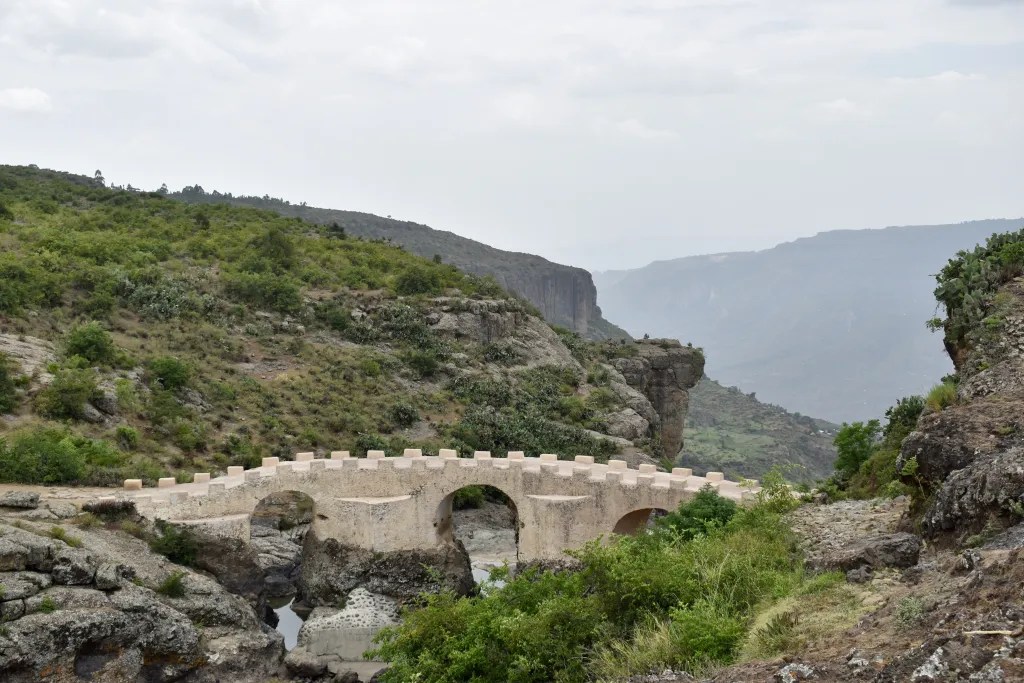


One minus point – as we were leaving, a fella approached us and said that we have to pay 575 birr each to the local municipality. He had a ticket machine and everything, but it sounded sketchy since we walked past him on the way to the bridge and he didn’t say a word. He was also, on top of that, selling trinkets, which didn’t add to his credibility!
There wasn’t anything to explore anywhere nearby, and it was also after 2 pm, so we headed back to Addis. The way back was easier as the road closure reopened. We made one small stop for a coffee and a sweet bread along the way.
Once we got back to the city, we asked our driver to drop us off at the Blue Mosque (Al Aqsa). This was at the northern end of Riverside Park (Sheger) that the city of Addis Ababa built alongside the Entoto River. We really liked the walk through it the other day, so we wanted to get our steps in by walking the whole length of it to our hotel. We both agreed that the park was the highlight of the city for us (except for the cheap and delicious coffee and beer). It was easy to walk and followed the main sights. It felt like a bit of nature in the heart of the city, and it wasn’t busy.
We stopped for a draft beer once we were near Meskel Square and for another one once we got to the end of the park. We didn’t know where to go for dinner, but we wanted to try Kitfo (minced raw beef). Since this place had it, we stayed and ordered a sample platter with about 8 different dishes. The platter came with Gored Gored (cubes of raw beef with sauce) and our favorite from last night, Doro Wat.


Day 3: Walking with the locals in Debre Zeit (Bishoftu)
We weren’t fussed on getting in the car again after the 6+ hours the other day, but we wanted to see more from outside of the city. Clare tried to organize the same driver to take us to Mount Zuqualla for a hike to the top of the extinct volcano and the Zuqualla Monastery with a possible stop at Bishoftu on the way back. It took a long time to agree on a price, just to get a message at 8 in the morning that we can’t go because the area is too dangerous. We were thinking about trying to arrange someone else, but gave up since it was so last minute.
Instead, we went for breakfast (again amazing) and decided to visit the town of Bishoftu on our own. We read a few articles, and most of them said it should be safe, so let’s go!
We got a taxi to Kality Menaharia (the bus terminal) in the southern part of the city. There we bought two tickets for a shared van to Bishoftu for 120 birr per person. The van/bus was small, and people were laughing because I couldn’t fit, but the ride was short. It took about 50 minutes.
Bishoftu
— also known as Debre Zeit — is a scenic resort town located about 45 kilometers southeast of Addis Ababa. It is famous for being built around five crater lakes. It is a popular getaway destination for locals.
We were suddenly in the middle of this town as the only white people there, and the first thing was that we had a swarm of kids around us asking for money. It got to the point that Clare had a kid wrapped around each leg and couldn’t walk. It was sad, but as we couldn’t give money to everyone, we had to “shake” them off (some people around helped) and then gave something to the most relentless ones.
Our first goal was to get the hell away from the town center and towards Hora Lake, the largest of the crater lakes in Bishoftu. It was about 3 km, and we made a quick stop for coffee as we went. We couldn’t really see the lake from the road, because there were restaurants and bars along the rim of the crater from the south. Clare spotted a Tej place, and we took the opportunity to stop to try the traditional Ethiopian honey wine and get our bearings.
The people in the bar didn’t speak English, but they were very friendly, and we managed to get two samples of different wines and a glass between us for 100 birr. It was nice and sweet with just a small hint of alcohol. We sat on their terrace overlooking the lake when we noticed that there was a fully laid path along the lake that we couldn’t see anywhere on our map. There was no access from the bar, but a bit further down the road along the rim, there was a park with an open gate.


We walked along Hora Lake, which felt like being fully in nature with the lush grass and trees all around, until we got to another gate on the north side. We then headed further north along the main road, being followed by a group of kids who were just leaving school. They were exercising their English with an occasional “Money, money” or “China”, which we had been called several times, so we think it meant foreigner.
In about 2 km, we reached Kuriftu Lake. This was the smallest lake, but unfortunately, not accessible as it was surrounded by resorts and a water park, and entry was paid. We were at least able to see it a wee bit through a fence.
We walked back a bit on ourselves, and just across the main road there was supposed to be another lake called Babogaya. We couldn’t see this one either but saw that there were hotels around. The first hotel wanted to charge us 600 birr just to go to the water (as it was a day pass for their facilities), but the next one (Pelican Paradise Resort Hotel) let us go down to the water and use their bar. We spent the next hour sitting by the water drinking some new brands of beer we hadn’t tried before. It was needed since it was a hot day.


This was a nice end to our journey through Bishoftu, as it was time to head back to the bus terminal. We got a lot of looks walking through the town, but never felt like we were in danger or anything. Once we reached Hora Lake, we joined the path where we left off and finished the whole loop. Just before we got to the terminal, we tried to make one more final stop at the last lake, Bishoftu Lake. But from the direction that we used, it was surrounded by a high green metal fence, and we didn’t even know if it was for construction or because of resorts. We didn’t feel like trying to walk around to find some entrance.
At the bus terminal, we got directions for the ticket office and paid again 240 birr for two seats back to Addis (look for Kality/Qality). We were back in the city under an hour and got dropped just across the street from the Kality Bus Terminal, where local city buses were already waiting, and fellas were shouting routes. Before I even got out of the minivan, Clare already had another one for us to Bole, where our hotel was. Even though we didn’t leave the city, this bus trip took about an hour too, because we were waiting until we had enough people and then stopping every 20 meters to collect more. We got off at the airport and walked the rest of the way to our hotel (about 1.5 km). We paid 100 birr for both of us.
The Cost Breakdown
Just to put the economics of DIY travel here into perspective: we had asked a budget driver (just a driver, no guide) to quote us a private day trip to Bishoftu, and he wanted 10,000 ETB.

By doing it on our own using local transport, we spent:

700 ETB on the initial taxi to the Addis bus terminal

480 ETB for our round-trip minivan tickets to and from Bishoftu

100 ETB for the public city bus back to Bole

Total Spent: 1,280 ETB (roughly $7). Not bad at all!
We were exhausted, but ready to eat. We decided that it was the night to go visit one of the traditional local restaurants in Addis. The other places we have visited were also local, but the Traditional/Cultural restaurants came with dancing and singing. We chose a place called 2000 Habesha Cultural Restaurant that was only about a 10-minute walk away.


The prices for food and drinks were higher, but they already included the show, so there wasn’t any extra entry fee. We got Lamb Fir Fir (pieces of lamb with torn injera), Key Wat (red stew with beef), and Bozena Shiro. We also got a beer each and enjoyed the show. They were alternating between singing and group dancing, and they were running non-stop. Definitely glad we spent the few extra birr to go watch it.
Day 4: Walking with the locals in rural Addis Ababa – Entoto Mountain
Similarly to the night before, and because we arrived kind of late, we couldn’t organize a trip anywhere we wanted to go. However, we had Entoto Mountain on our list anyway, and since it was just above the city, we didn’t need a driver for the day. We said we were going to do it on our own again and see if we could get something organized for the last day.
After breakfast, we got a taxi to a roundabout at the end of Omedia Street at the edge of town (9.0627794N, 38.7892131E). The paved road ended there, where we attracted some looks from the locals at the small market. That is where we started the trek to Entoto Mountain. As we started walking the dirt path uphill and out of town, we were a bit afraid of the people’s reaction, but everyone seemed to become friendlier.
The path was going steadily up with a few flat bits in between. When we reached the last village, 5 km and a little over an hour, we spotted a wee shop and got a Coke. We met some nice people there and bought a Fanta for one older lady who originally wanted a candy. This was one of the occasions where the other people could ask for anything, but they were just happy to see us there.


It was another almost 3 km until we reached the end of the path and the newly built road at the ridgeline of the mountains. From there we had only 1 km on the tarmac road to the highest point of the ridge, Mount Entoto. But as we were getting closer, we could see more fences and military installations. There was a dirt mound next to it, but thinking that they might mistake us for spies, we decided to call it quits on the road. The way up was just under 10 km and about 600 meters of elevation gain. We made it in 1:40 hours.
After a wee refreshment and a photo (also must have looked like we were spying on them), we headed back. We could have followed the new road, but that would be boring. Instead, the two of us headed down to the edge of the last village, where we turned west to traverse the mountainside. It was just the end of the day for the local school, so we had several companions as we passed two small villages on the way. Our goal was to get to the Entoto Mariam Church on the west side of the Entoto Mountain ridge.


It was 8 kilometers away, but mostly flat, so it took us just a bit over an hour to get there. It was the 29th of May, and because that is Saint Mary’s Day in Ethiopia, the place was teeming with people. We saw lines of people waiting for buses to get back to the city and more still coming in. So rather than right away joining the hustle and bustle of the place, we made a stop at a wee woman’s stand for coffee.
There were a few people calling us to go sit with them. They were nice and wanted to talk to us, but none of them spoke English. We got a coffee and some beans with mustard to try. They were also drinking some black liquid, but we didn’t ask for any. That’s something I regret because later I thought it could have been Tella, a local home-brewed beer!
Eventually, a guy showed up and spoke a bit of English, but I would describe him as annoying and rude, “a wally” in Dan’s words. He would tell us a bit about the local area and what was happening there that day, but he acted very patronizing towards the other people and how he talked about them, calling them farmers and uneducated. Who, from all of them, do you think came in the end asking for money? The least we could have done was pay for a round of drinks for everyone.
Entoto Mariam Church was built in the late 19th century by Emperor Menelik II. That is why there is also a museum of royal artifacts on the right side of the entrance. As foreigners, we were asked to pay an entrance fee to the museum even when we just wanted to visit the church. It was 600 birr each. We got a bit “scammed” in the crowd at the entrance and bought a ticket before for 200 each, which we later found out was a charity donation – a good type of scam.


Before we left and started going down the hill towards the city, there was time for one more good deed. We wanted to buy a small souvenir for ourselves (a wooden cross). While we were deciding, a woman approached us and asked if we would buy her a pocket Bible. In the end, she got a pocket Bible with a nice cowhide pouch with a strap to carry it in.
The whole day was overcast with occasional sun rays, but as we were leaving the church, the sky got way darker, and people started walking quickly past us or even running. We knew what was coming, but there was nothing else to do but hope for shelter. When it started hammering hard, we found some dense trees to hide under. Once the rain died down and we saw other people coming out of their covers, we continued walking, and the rain, luckily, didn’t come back.
We didn’t stop until we reached the town and heard kids from a local school cheering out loud because they were probably let home early due to the rain. By this time, we had well over 20 km in our legs, and it was time to stop for a beer. We walked to the first place that seemed like they could have a beer on our side of the road, and it was class! The place was full of people, with a nice atmosphere, and served draft Habesha (our favorite) beer and had Tej.


This was at the edge of Shero Meda, a part of the town known for its large textile market. We saw the market building, but we were all wet and tired, so we just passed by it and didn’t go in. I don’t know why I agreed to it, because my feet were on fire from the walking for some reason, but we again joined Riverside Park (this time at the actual northern edge) to walk to the hotel instead of getting a taxi.
A stop near Meskel Square for a beer was needed. This time we couldn’t resist and got something to eat as well. It wasn’t a local place, so pizza and chips it was.


We reached our hotel after sunset and were so tired that we didn’t even go for another dinner. Instead, we bought some sweets at a corner store and tried to organize a car for the next day.
Day 5: Rainy day and Champions League Final
If you survived reading all the way to here, you probably guessed it—we weren’t able to organize a car again. 🙁
Our first choice for the day was the Suba Menagesha National Forest, the oldest state-protected forest in Africa, located about 30 km west of Addis Ababa. However, we were pretty tired and had done a good bit of walking over the previous two days, so we didn’t feel like we could get the most out of it anyway and wanted to do something else. On top of that, it was also supposed to rain heavily starting from 12 pm.
The second option was to drive south to Tiya and visit the UNESCO archaeological site there, along with the Adadi Mariam Rock-Hewn Church, Melka Kunture, and the Awash River gorge. But absolutely no one would take us there. We were told that due to the upcoming elections (in two days), the area was not safe to visit. To be honest, we met a guide on our first day and then ran into him again later today, and he said the exact same thing: that it would be incredibly hard to find someone willing to drive us down there right now.
In the end, since we couldn’t find anyone who would take us to the forest and wait for us either, we stayed in the city and went to visit the Ethnological Museum instead. We paid 200 birr each (you should pay online via an app, but the lady took cash as well) and spent about an hour exploring. It was very well done and housed inside an old palace of Haile Selassie (the last Emperor of Ethiopia), which he had donated to Addis Ababa University. The exhibits gave us a bit better sense of the history of Ethiopia, the fight against colonialism, the rise of the Derg, and the subsequent communist regime.


From there, we followed the main road to the Holy Trinity Cathedral and actually managed to get in this time. The 1,500 ETB entry fee already included a guide who met us inside the cathedral and gave us a detailed tour. Inside the cathedral is the tomb of Emperor Haile Selassie and his wife, Empress Menen Asfaw. On the grounds, there is also a small museum containing different royal and religious relics, as well as the Church of the Holy Child.
The Death of the Emperor
After his deposition in September 1974 by the Derg, Haile Selassie was kept under house arrest in the Grand Palace in Addis Ababa. The official statement at the time was that he died in August 1975 of natural causes linked to a prostate operation or respiratory failure. However, many historians believe that he was murdered to prevent any possibility of his restoration to power.
Not being able to organize a car to get out of the city, as annoying as it was, turned out to be a blessing in disguise. Clare hadn’t been feeling 100% since the morning, and by this time the illness was really getting to her. Instead of walking the same path back to the hotel, we flagged down the first taxi we could find and headed straight back to the room. Clare went right to bed to get some much-needed rest, and it didn’t take long for the heavy rain to start pounding down again.


The sleep was definitely required. I didn’t mention it before, but our hotel room was surprisingly warm at night, and it was hard to sleep with the balcony door open because the nightclub near us played loud music until 6 am every morning!
Around 5 pm, we headed back out. We walked past the large St. Medhanialem Church to a Tomoca Coffee to get a macchiato, since we saw it the first time we were there and regretted we didn’t order it. It tasted as good as it looked. We then walked back on ourselves to find some place to get dinner. We were also looking for a place to watch the Champions League Final game at 7 pm, and stumbled upon MK’s Kitchen Bar. So we stopped for dinner at BGS Poultry Farm a minute down the road for a quick Shawarma and Fassa (like a curry, similar to Doro Wat). Then quickly back to get a seat at the bar.


We had a few pints and almost missed the penalties as the rain came back again and the TV lost signal. Everyone in Addis was an Arsenal fan, so it was hard to see them lose. But that didn’t stop them partying as we heard people on the streets and in the club while we were packing our things to go to the airport.
If you have any Ethiopian birr leftover, don’t expect that you can change it back at the airport. It was also not easy to use them there, as all prices were in dollars and about five times as much as in the city. But the lounge was class and well worth the one complimentary visit per year we had on our credit cards.
Ethiopia was a great experience, and we were really glad we could visit another African country, especially since we haven’t explored the continent too much yet. It was a bit unlucky that we couldn’t explore as much as we originally wanted, but I still feel like we got the most out of our short time there. We absolutely loved the food and really got used to eating injera every single day. And the beer? Cheap and surprisingly good. I would honestly kill for a cold pint of Habesha right now!
Hopefully one day we can come back and explore the northern parts of the country: the ancient capital of Aksum, the rock-hewn churches in Lalibela, the castles in Gondar, and of course the mountain ranges like the Simien and Bale Mountains.